


Hillary Clinton to visit Middle East over Gaza conflict
US secretary of state breaks off from Asian tour with Obama as efforts to broker a ceasefire intensify
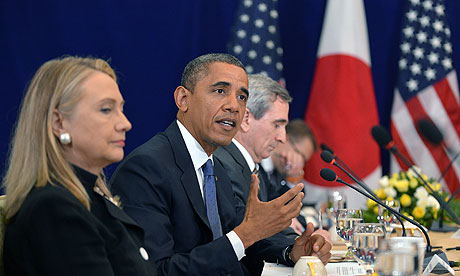
Hillary Clinton and
Barack Obama in Cambodia. She will now break off from the south-east
Asian tour to travel to the Middle East, Photograph: Jewel
Samad/AFP/Getty Images
Hillary Clinton is en route to the Middle East to join efforts to broker a ceasefire in the war between Israel and Hamas, in a move that suggests a breakthrough is close.
The US secretary of state, who had been accompanying Obama on his visit to south-east Asia,
left Cambodia on Tuesday for talks in Jerusalem, Ramallah and Cairo,
where she will meet the Israeli prime minister, Binyamin Netanyahu,
Palestinian officials and Egyptian leaders.
Gaza
City was relatively quiet overnight, but the Israeli military said it
had struck 100 targets over the coastal strip, including the Gaza
headquarters of the National Islamic Bank.
Five rockets were fired
from Gaza during the course of the night, following a pattern of
reduced missile launches for the past three nights. Rocket fire resumed
on Tuesday morning.
A possible ground invasion by Israeli troops
is on hold while talks in Cairo continue. However, there was evidence of
the military buildup along the border with a heavy presence of
reservist soldiers.
In Cairo, the UN secretary general, Ban
Ki-moon, warned that further escalation in the conflict could endanger
the region. "This must stop, immediate steps are needed to avoid further
escalation, including a ground operation," he said. He is to visit
Jerusalem on Tuesday for talks with Netanyahu before heading to Ramallah
to see the Palestinian president, Mahmoud Abbas.
Netanyahu
met members of his security cabinet overnight. A senior Israeli
official told Reuters after the meeting: "Before deciding on a ground
invasion, the prime minister intends to exhaust the diplomatic move in
order to see if a long-term ceasefire can be achieved."
A White
House spokesman said Clinton would make clear an escalation of the
conflict would be in nobody's interest. The US, Britain and other
western governments have urged Israel not to mount an assault similar to
Operation Cast Lead, in which 1,400 Palestinians in Gaza were killed
four years ago.
By Tuesday, civilians accounted for 54 of
the 113 Palestinians killed since the operation began. Some 840 people
have been wounded, including 225 children, Gaza health officials said.
Three Israelis have been killed by Palestinian rocket fire.
Khaled
Meshal, the Hamas leader, who was in Cairo for talks on Monday, told
reporters Israel must be the first to halt military operations since it
had begun them last week by assassinating the movement's military chief, Ahmed al-Jaabari.
"A ground invasion will not be a walk in the park," Meshal warned. "We
don't have the same military and deterrence capabilities [as Israel] but
we have deterred them with our will. Our enemy is drowning in the blood
of children."
Officials in Jerusalem flatly denied Meshal's claim
that Israel was seeking a ceasefire. It was Hamas, one official said,
that was looking for a way to "climb down" after more than 400 air
strikes in Gaza had significantly eroded the Palestinians' ability to
launch missiles at Tel Aviv and other Israeli cities.
But
diplomats in Jerusalem and Tel Aviv were hopeful a deal could be
forged. "The fact that the talks are still going on is a good sign,"
said one. "And the fact that Israel hasn't yet gone in on the ground is a
good sign."
The Cairo truce talks ran into trouble on Sunday
after news that 10 members of one family had been killed in Gaza in an
air strike apparently aimed at killing a Hamas or Islamic Jihad leader.
British
officials monitoring the crisis said the key was to de-escalate, secure
a durable ceasefire, and then return to the key questions of promoting
reconciliation between Hamas and the Palestine Liberation Organisation
and re-invigorating a moribund peace process.
The British foreign
secretary, William Hague, said in Brussels: "I am pleased that Israel
has held back from a ground invasion while such negotiations go on, and
that the rate of rocket attacks on Israel has fallen, for whatever
reason, over the last 24 hours. These are positive developments, but of
course it remains a desperately serious and difficult situation."
Palestinian
sources said that Abbas had responded angrily on Monday to Tony Blair,
the Middle East Quartet's (the UN, US, EU and Russia) envoy, in a
meeting in Ramallah. Blair is trying to persuade Abbas to refrain from
seeking observer status at the UN – a move opposed by the US and Israel.
Abbas reportedly told him to leave if he was not there to talk about
the crisis in Gaza.
Israeli sources made clear that a ceasefire
deal would have to mean an end to all hostile fire from Gaza into
Israel, including small arms fire at troops near the border. Hamas
fighters must also be stopped from crossing into Sinai to mount attacks
against Israel from Egyptian territory. Hamas must not be allowed to
rearm. Any ceasefire must not be a simple "time out" for Hamas but
provide an extended period of quiet for southern Israel.
Support
for Operation Defensive Pillar remains solid in Israel. According to an
opinion poll in the Haaretz newspaper, 30% of the Israeli public support
a ground invasion despite the risk of high casualties. Overall the
operation has the backing of around 84% of the public, with 12% opposed.
But
in one sign of dissent, 100 writers, intellectuals and artists on
Monday issued a petition calling for a long-term ceasefire, and more
significantly for talks with Hamas, which has long been a political
taboo. "We must speak out because the people of southern Israel, like
the people of Gaza, deserve to be able to look up at the sky in hope and
not in fear," wrote the author Amos Oz, playwright Yehoshua Sobol and
others.
Additional reporting by Abdel-Rahman Hussein in Cairo





.jpg)


0 orang berkata:
Post a Comment